

In its second year, the sports education project of the Russian Olympic Committee has expanded beyond our country’s borders.
Today, the sports dictation supported by Rossotrudnichestvo was conducted in the Russian Houses across Kazakhstan, Tajikistan, the Republic of Belarus, and various countries both near and far.
Kazakhstan’s capital, Astana, has become one of five locations connected via a space bridge to the National Centre RUSSIA in Moscow, where Minister of Sports of the Russian Federation, President of the Russian Olympic Committee Michael Degtyarev kicked off the ‘Sports Dictation’ event.
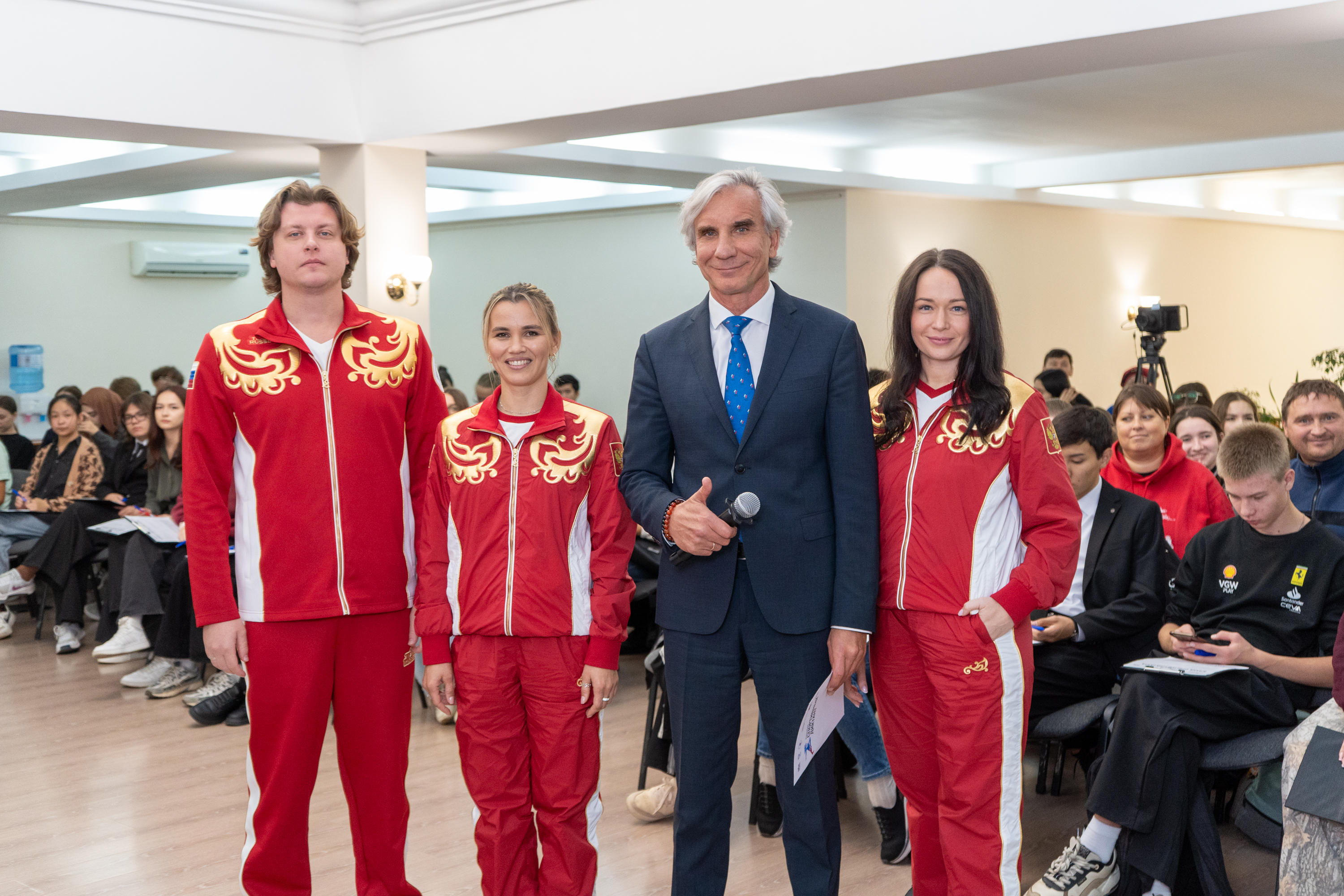
One of the 25 dictation questions for all participants from the Russian House in Astana was read in real time by Irek Zinnurov, the Head of the Russian Center of Science and Culture, a two-time Olympic medalist in water polo. The Kazakhstani segment of the project saw active involvement from the Tokyo Games medalists, including Aleksandr Krasnykh in swimming, Gulnaz Khatuntseva in cycling. Additionally, one of the country’s top skeleton racers, Olga Denshchikova, also contributed to the initiative.
They not only tackled challenging questions during the dictation, but they also engaged with students from higher education institutions and local young athletes, who filled to capacity the building that used to house the Embassy of the Russian Federation in downtown Astana.
Over 100 people responded to the call for the sports dictation, with some traveling to Astana from various cities of Kazakhstan just for this event.
In the hall, people from various generations gathered, all genuinely eager to find the right answers among the four options provided for each question. Afterwards they spent over an hour chatting with some distinguished Russian guests about their sports careers, discussing major victories and the challenges they have faced, and got autographs and took photos with the champions.
- I believe it was worthwhile to hold the Sports dictation here in Astana, specifically for this component of the ROC project. Informal communication with athletes has become a valuable addition to today’s events. For the younger generation, it is essential to understand the stories behind global sports and the Olympic movement. However, what is even more important is the chance to learn directly from athletes about achieving success in sports and developing both physical and mental well-being, - Irek Zinnurov noted.
Aleksandr Krasnykh was truly impressed by how eager all the participants were to answer every question in the dictation correctly.
- Everyone had that intense focus in their eyes, and it was heartwarming to see both children and adults passionately searching for the right answers. We all had to think hard, including the athletes. Personally, I struggled with some questions about winter sports. However, in the end, everyone walked away with new knowledge, which means the dictation successfully achieved its main goal, - the silver medalist from the Tokyo 2020 Olympics maintained.
Gulnaz Khatuntseva confessed to having been interested in exploring her knowledge of sports and being eager to discover more about the new country.
-Thank you so much for the invitation to be part of this amazing project with the ROC! It was my first time visiting Kazakhstan, and I was excited to explore the country that is new to me, especially since my sport is quite popular here. Participating in the dictation felt like taking an exam, which was an interesting experience. When I got to the part about ‘Anna Karenina’, I honestly thought Leo Tolstoy was referring to a bicycle in his masterpiece. Now I realize he was talking about tennis, - the bronze medalist at the Tokyo Olympics said.
Olga Denshchikova pointed out that projects like these not only serve educational purposes but also play a significant role in inspiring young people to get involved in sports.
- New knowledge and engaging with athletes can be a powerful source of motivation to explore new sports. It is never too late to start. Personally, I began my journey in skeleton at 18, and it did not stop me from becoming a national champion and competing in the Olympic Games. Opportunities like that are invaluable for any athlete!