
Badminton
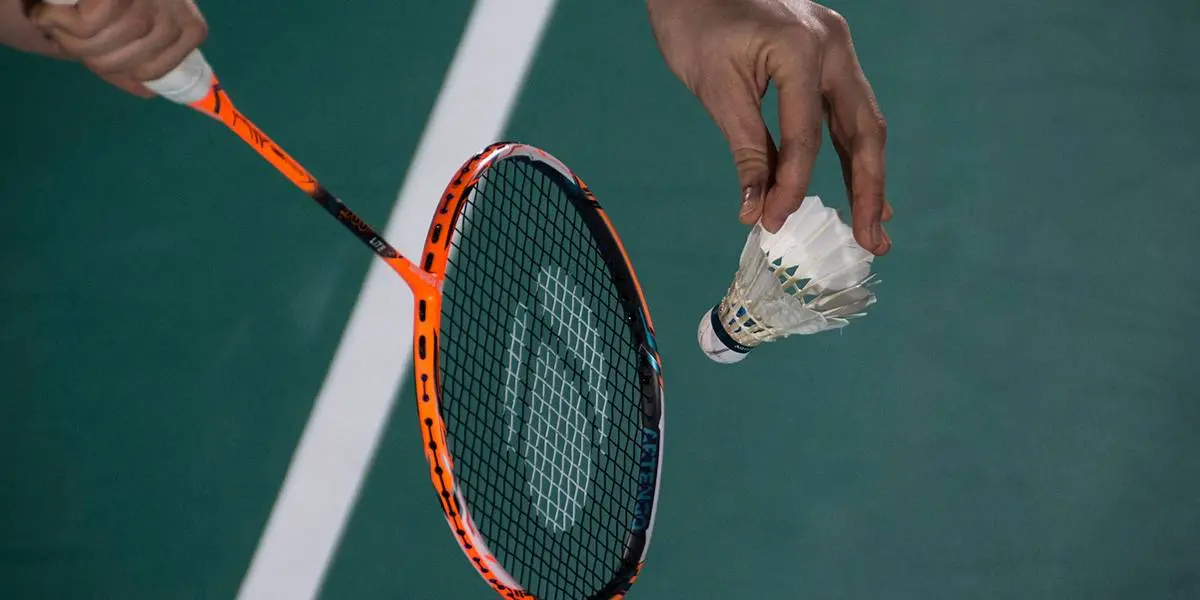
Badminton is a racket sport in which players stand on opposite sides of a court divided into two halves of specified dimensions and hit a shuttlecock over a net using rackets, aiming to win the match.
Rules of the Game
Before the match begins, a coin toss is held. The winner of the toss has the right to choose either to serve or to sel ect a side of the court. The game starts fr om the right service court. The serve must be struck underhand, and at the moment of impact the racket head must not be higher than the server’s waist.
The server and the receiver must stand within their diagonally opposite service courts, without stepping on the boundary lines and without moving fr om their positions at the moment of striking the shuttlecock. Feinting and hitting the feathers of the shuttlecock during the serve are not allowed. Each rally results in one point being awarded to one side.
A rally ends when the shuttlecock:
- Hits the net or post and begins to fall toward the court surface on the striker’s side;
- Touches the court surface (within or outside the boundary lines);
- Is declared a “let,” “stop,” or a fault is called.
Scoring System
- A match consists of three games played to 21 points (best of three games).
- The side that wins a rally adds one point to its score.
- At a score of 20–20, the side that wins two consecutive points wins the game.
- At 29–29, the side that scores the 30th point wins the game.
- The side that wins a game serves first in the next game.
Interesting Facts
- The first badminton association was established in England, wh ere the game had been introduced by British military officers returning from India. The sport takes its name from Badminton House, the estate of the Duke of Beaufort.
- The oldest existing badminton tournament has been held since 1898.The badminton shuttlecock is the fastest projectile in racket sports. The officially recorded speed record is 493 km/h.
- Due to the nature of the game, badminton has a beneficial effect on players’ eyesight. A method of vision improvement through badminton has been protected by Russian and international patents.
Olympic Games
Badminton became part of the Olympic Games program in 1992 in Barcelona, when four sets of medals were awarded. In 1996, an additional event was introduced, bringing the total to five medal events, which remains unchanged to this day. The greatest Olympic success has been achieved by athletes from Asia, particularly from China, Indonesia, and the Republic of Korea.
Russia
In the USSR, badminton was officially included in sports competitions for the first time in 1957 during the 6th World Festival of Youth and Students.
Over the past decade, badminton in Russia has seen significant progress. During this time, the country won its first Olympic medal (bronze, 2012), its first European Championship gold medals (2010, 2014), as well as numerous other medals at continental championships and World Super Series tournaments.
Russian deaf badminton players have become world, European, and Deaflympic champions. Russian para-badminton athletes have also achieved international success, winning medals at World Championships and becoming European champions and medalists. Notably, badminton was included in the Paralympic Games program in 2020.
There has also been growth in amateur badminton, supported by its inclusion in the school curriculum as part of a third physical education class.
Our Olympians